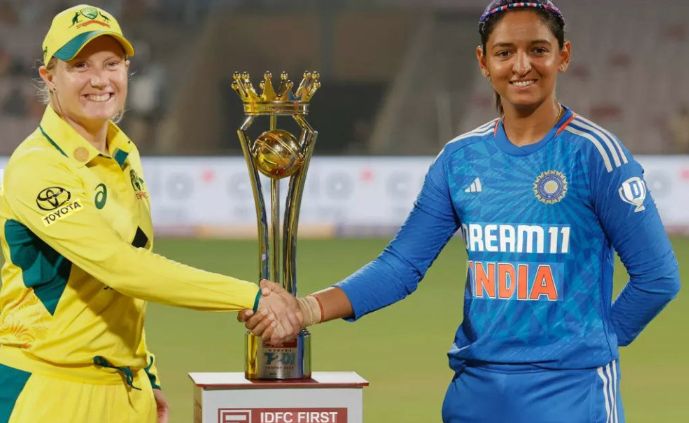
The Australia Women’s National Cricket Team vs India Women’s National Cricket Team stats reflect a rivalry that has grown from dominance to intense competition. What started as a one-sided contest soon transformed into one of the most compelling battles in women’s cricket. Australia’s early control set the benchmark, but India’s steady rise brought new energy and belief into the contest. From World Cup clashes to bilateral series, every match has added depth, drama, and unforgettable moments. Scorecards are no longer just numbers, they tell stories of pressure, resilience, and brilliance that continue to shape this evolving rivalry.
Latest Matches
Date
Tournament
Venue
Winner
Scorecard
06 Mar 2026
Bilateral Test
WACA, Perth
Australia
AUS 323 & 28/0, IND 198 & 149
01 Mar 2026
Bilateral ODI
Ninja Stadium
Australia
AUS 409/7, IND 224
27 Feb 2026
Bilateral ODI
Ninja Stadium
Australia
AUS 252/5, IND 251/9
24 Feb 2026
Bilateral ODI
Allan Border Field
Australia
AUS 217/4, IND 214
21 Feb 2026
Bilateral T20I
Adelaide Oval
India
IND 176/6, AUS 159/9
19 Feb 2026
Bilateral T20I
Manuka Oval
Australia
AUS 163/5, IND 144/9
15 Feb 2026
Bilateral T20I
SCG, Sydney
India
IND 50/1 (5.1), AUS 133
Head-to-Head Summary Table
Format
Matches
Australia Wins
India Wins
No Result / Draw
Test
11
4
1
6
ODI
54
43
11
0
T20I
35
26
8
1
Best Player Analysis Table
Player Name
Team
Role
Key Strength
Impact Rating
Alyssa Healy
Australia
Wicketkeeper Batter
Explosive Opening
9.5
Smriti Mandhana
India
Opening Batter
Elegant Strokeplay
9.2
Ellyse Perry
Australia
All-Rounder
Clutch Performance
9.8
Deepti Sharma
India
All-Rounder
Economical Bowling
8.9
Beth Mooney
Australia
Batter
High Consistency
9.3
Renuka Singh
India
Bowler
Early Swing
8.7
Top Run Scorers All-Time
Player
Team
Total Runs
Matches
High Score
Mithali Raj
India
1198
38
109
Ellyse Perry
Australia
1156
45
213*
Harmanpreet Kaur
India
1084
42
171*
Meg Lanning
Australia
1021
32
101*
Smriti Mandhana
India
985
35
127
Alyssa Healy
Australia
942
39
129
A One-Sided Era Australia’s Early Control Over the Rivalry
Australia dominated the early years of this rivalry with ruthless consistency and tactical brilliance. Their batting depth, disciplined bowling, and sharp fielding exposed India’s inexperience on the international stage. Match after match, the scorecards reflected a clear gap in quality, with Australia often posting big totals and restricting India under pressure. Players like Belinda Clark and later Meg Lanning set the tone with commanding performances, while bowlers executed plans with precision. India struggled to build partnerships or defend totals, often collapsing in crucial moments. These encounters were not just defeats but learning curves, where India began to understand the demands of elite cricket. Australia’s aggressive intent and confidence made them nearly unbeatable, turning the rivalry into a one-sided contest. Yet, even in losses, small flashes of resistance from India hinted at a future shift, planting the seeds of belief that this dominance would not last forever.
Year
Format
Winner
Key Player
Margin
2005
ODI
Australia
Karen Rolton
98 runs
2008
ODI
Australia
Lisa Sthalekar
7 wickets
2010
T20I
Australia
Ellyse Perry
6 wickets
2012
ODI
Australia
Meg Lanning
9 wickets
India’s Slow Rise Finding Identity and Belief
India’s journey from underdogs to competitors was gradual but determined. They began focusing on building a stable batting core and developing bowlers who could challenge Australia’s dominance. Mithali Raj’s calm leadership and consistency brought structure, while emerging players like Smriti Mandhana added flair and aggression. Close matches started replacing one-sided defeats, and India began pushing Australia into uncomfortable situations. The scorecards showed narrower margins, improved partnerships, and better bowling spells. Confidence grew as India realized they could compete at the highest level. Fitness standards improved, fielding became sharper, and tactical awareness increased. Though Australia still held the upper hand, India’s belief was no longer fragile. Each match became a contest rather than a formality. This phase marked the emotional shift in the rivalry, where India stopped fearing Australia and started challenging them with intent and resilience, slowly rewriting the narrative of this historic clash.
Year
Format
Winner
Key Player
Margin
2013
ODI
Australia
Jess Jonassen
4 wickets
2014
ODI
India
Mithali Raj
2 wickets
2016
T20I
India
Harmanpreet Kaur
7 runs
2016
ODI
Australia
Meg Lanning
3 wickets
World Cup Clashes When Pressure Reached Its Peak
When these two teams met in World Cups, the intensity reached another level. Every run, every wicket carried immense pressure, and the scorecards told stories of high stakes and nerve-wracking finishes. Australia entered as favorites, backed by experience and a winning mentality, while India played with hunger and nothing to lose. These matches often saw dramatic momentum shifts, with individual brilliance deciding outcomes. Bowlers thrived under pressure, and batters had to dig deep against world-class attacks. The crowd energy and global attention amplified every moment. India’s performances improved significantly in these encounters, proving they could stand tall on the biggest stage. Australia, however, maintained their composure in crunch moments, often edging out victories. These clashes became defining chapters, shaping the rivalry into a global spectacle and raising the standard of women’s cricket worldwide.
Year
Event
Winner
Key Player
Result
2009
World Cup
Australia
Shelley Nitschke
7 wickets
2013
World Cup
Australia
Meg Lanning
8 wickets
2017
World Cup
Australia
Perry
36 runs
2020
T20 WC
Australia
Alyssa Healy
85 runs
The 2017 World Cup Final The Night That Changed Everything
The 2017 World Cup final remains one of the most emotional and defining matches in this rivalry. India entered the final with momentum and belief, while Australia relied on experience and composure. The match swung like a pendulum, with India’s bowlers creating early pressure and restricting Australia to a manageable total. During the chase, India looked in control before a sudden collapse changed everything. The scorecard reflected heartbreak, as wickets fell in clusters and dreams slipped away. Harmanpreet Kaur’s earlier heroics in the tournament had raised expectations, but the final proved how cruel cricket can be. Australia capitalized on small mistakes and held their nerve in crucial moments. This match transformed the rivalry emotionally, as India gained respect and recognition despite the loss. It was no longer about dominance but about fine margins, pressure handling, and the mental strength required to win on the biggest stage.
Match
Venue
Winner
Top Performer
Result
Final 2017
Lord’s
England
Anya Shrubsole
9 runs
Semi Final
Derby
India
Harmanpreet
36 runs
League
Bristol
Australia
Perry
8 wickets
League
Derby
India
Mandhana
7 wickets
Bilateral Series Battles Strategy Meets Adaptation
Bilateral series between Australia and India became tactical battlegrounds where strategies evolved constantly. Teams analyzed weaknesses, adjusted combinations, and experimented with game plans. Australia focused on aggressive starts and disciplined bowling, while India emphasized spin variations and controlled batting. Home conditions played a crucial role, with pitches influencing team selections and match outcomes. Scorecards from these series highlighted balanced contests, with both teams winning matches and pushing each other to improve. India’s ability to adapt to Australian conditions improved significantly, while Australia learned to counter India’s spin attack effectively. These series were not just about results but about preparation, planning, and execution. Each match added a new layer to the rivalry, making it more competitive and unpredictable.
Series
Format
Winner
Key Player
Scoreline
2018
ODI
Australia
Lanning
3-0
2021
ODI
Australia
Perry
2-1
2021
T20I
Draw
Mandhana
1-1
2022
ODI
India
Harmanpreet
2-1
Captaincy Battles Leadership That Shaped the Rivalry
Leadership played a defining role in shaping this rivalry, with captains influencing outcomes through decisions and mindset. Meg Lanning’s calm and calculated approach gave Australia an edge in pressure situations, while India’s leaders like Mithali Raj and Harmanpreet Kaur brought resilience and adaptability. Field placements, bowling changes, and batting orders often decided tight matches. The scorecards reflected these decisions, showing how small tactical moves led to big results. Lanning’s ability to read the game and stay composed under pressure made her one of the most successful captains, while India’s evolving leadership brought new energy and belief. These captaincy battles added a psychological dimension to the rivalry, where strategy met instinct. It was not just about players but about leaders guiding their teams through intense moments, making every match a chess game on the field.
Captain
Team
Matches
Wins
Win %
Meg Lanning
Australia
50
40
80%
Mithali Raj
India
60
35
58%
Harmanpreet
India
30
18
60%
Healy
Australia
20
15
75%
Conclusion
Today, the Australia Women’s National Cricket Team vs India Women’s National Cricket Team stats showcase a rivalry built on respect, intensity, and high-quality cricket. The gap that once existed has narrowed, turning every encounter into a closely fought battle. Players on both sides have delivered match-winning performances, while captains have shaped outcomes with sharp strategies. This rivalry now stands as a symbol of the growth of women’s cricket globally. With rising talent and increasing competition, the future promises even greater contests, where every scorecard will continue to tell stories of passion, pressure, and pride.