Table of Contents
India and South Africa have developed one of international cricket most competitive rivalries, featuring world-class batters, fast bowlers, spinners and memorable finishes. Since South Africa returned to international cricket in 1991, the two teams have met in bilateral series and major tournaments across Test matches, One Day Internationals (ODIs) and Twenty20 Internationals (T20Is).
The rivalry has produced historic centuries, dominant bowling performances, close World Cup contests and important series victories in both countries. While South Africa have historically performed strongly in Tests and ODIs, India have built a stronger record in T20 internationals.
This article covers the India national cricket team vs South Africa national cricket team matches, including head-to-head statistics, important series, memorable encounters and key records.
India vs South Africa Head-to-Head Record
India and South Africa have played across all three major international formats. Their overall results demonstrate how the balance of power changes depending on the format and playing conditions.
The following figures reflect the men’s international head-to-head record through the latest results available in the cited statistical compilations.
| Format | Matches | India Wins | South Africa Wins | Draws or No Results |
|---|---|---|---|---|
| Test cricket | 46 | 16 | 20 | 10 draws |
| One Day Internationals | 97 | 42 | 52 | 3 no-results |
| T20 Internationals | 36 | 21 | 14 | 1 no-result |
| Total | 179 | 79 | 86 | 14 |
These figures show that South Africa have the advantage in the longer formats, while India lead in T20Is. Test matches include drawn results, whereas ODIs and T20Is can end without a result when weather or other circumstances prevent a completed contest.
Head-to-head statistics can change after every series, so readers should check the latest official scorecards when comparing records at a later date.
Beginning of the India vs South Africa Cricket Rivalry
South Africa’s return to international cricket in the early 1990s marked the beginning of a new era for the team. India and South Africa first faced each other in an ODI in November 1991, with India winning by three wickets.
The teams began their Test rivalry during India’s tour of South Africa in 1992–93. South Africa won the four-Test series 1–0, while three matches ended in draws.
These early contests established the foundation for a rivalry shaped by contrasting conditions. Indian pitches often offered opportunities for spin bowling, while South African grounds became known for pace, bounce and movement.
For India, touring South Africa became an important test of batting technique and adaptability. South Africa, meanwhile, had to adjust to different surfaces and the challenges created by India’s spin bowlers.
Over time, both teams developed stronger squads and more experienced players, helping turn their meetings into major events on the international cricket calendar.
India vs South Africa Test Match History
Test cricket has traditionally been one of the most demanding parts of this rivalry. South Africa’s pace attack has often posed serious questions for visiting batters, while India have enjoyed considerable success on home pitches that reward patient batting and effective spin bowling.
The overall Test record gives South Africa the lead, with 20 wins compared with India’s 16. Ten matches have ended in draws.
Some important periods in the Test rivalry include:
- 1992–93: South Africa won the first Test series between the teams 1–0.
- 1996–97: India won their home series 2–1, registering an important success against South Africa.
- 2004–05: India won a home Test series 1–0.
- 2015–16: India won a four-Test home series 3–0.
- 2019–20: India completed a 3–0 home series victory.
- 2021–22: South Africa won a three-Test home series 2–1.
- 2023–24: The teams drew their two-Test series in South Africa 1–1.
- 2025–26: South Africa won their two-Test series in India 2–0.
India’s home dominance during several of these periods demonstrated the effectiveness of their batting depth and spin resources. South Africa’s away victories, however, showed how disciplined fast bowling and resilient batting could overcome difficult conditions.
The 2023–24 series was particularly notable because both teams secured a victory in South Africa. The result highlighted the competitive nature of the contest, even when one team has a clear advantage in its home conditions.
The 2025–26 series brought another significant result, with South Africa winning both Tests in India. It reinforced the importance of adapting to changing conditions and showed that historical home records cannot guarantee future success.
India vs South Africa ODI Matches
ODI cricket has delivered several high-scoring contests and memorable individual performances. South Africa lead the historical record with 52 wins from 97 matches, compared with India’s 42 victories. Three matches ended without a result.
The teams have met in bilateral ODI series, ICC Cricket World Cups and other international tournaments. Their encounters have often featured aggressive batting, partnerships under pressure and fast bowling during the final overs.
Important ODI Series and Matches
2000–01: Competitive bilateral cricket
The early 2000s featured closely contested encounters as both teams developed strong one-day squads. South Africa’s balanced batting and bowling attack made them a difficult opponent, while India’s experienced batters helped the team remain competitive.
2015–16: South Africa’s high-scoring performance
South Africa scored 438/4 against India in Mumbai in October 2015, winning the match by 214 runs. The result remains one of the most striking examples of South Africa’s ability to dominate a limited-overs contest through aggressive batting.
2017–18: India’s successful tour of South Africa
India won the six-match ODI series in South Africa 5–1. The result was a major achievement for the visiting side and demonstrated its ability to perform consistently in challenging overseas conditions.
2023: World Cup group-stage meeting
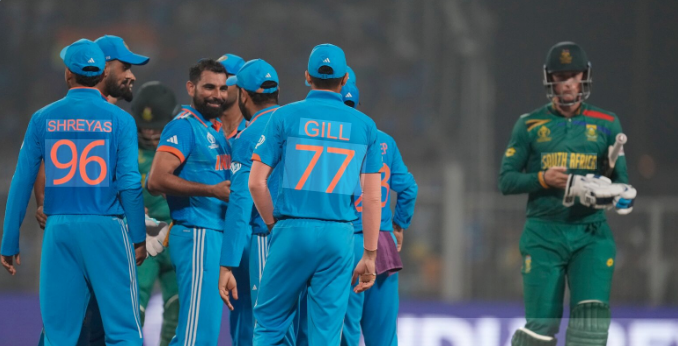
India defeated South Africa by 243 runs in the 2023 ICC Men’s Cricket World Cup. India posted 326/5, and South Africa were dismissed for 83. The emphatic victory was one of the tournament’s most notable results.
2025: India win the ODI series at home
India won the three-match ODI series against South Africa 2–1. South Africa won the second match, but India claimed victories in the first and third games to secure the series.
These matches show why ODI results cannot be explained by batting strength alone. Fielding standards, bowling changes, partnerships and the ability to handle pressure during the final overs can all determine the outcome.
India vs South Africa T20 International Matches
T20 cricket has provided another dimension to the rivalry. India’s record in this format is stronger than its record in Tests and ODIs, with 21 victories compared with South Africa’s 14, alongside one no-result.
Both teams have regularly produced explosive batting performances and aggressive bowling spells. The shorter format also gives individual players more opportunities to change a match in a few overs.
Some notable moments include:
- 2006: India won the first men’s T20 international between the teams by six wickets in Johannesburg.
- 2022: India recorded strong performances during their T20I series at home, including a 2–1 series victory.
- 2024: India defeated South Africa in the ICC Men’s T20 World Cup final by seven runs.
- 2024 bilateral series: India won a four-match T20I series in South Africa 3–1.
- 2025 bilateral series: India won the five-match T20I series 3–1, with one match abandoned.
- 2026 T20 World Cup: South Africa defeated India by 76 runs in Ahmedabad.
The 2024 World Cup final remains a defining moment. South Africa were chasing India’s target and appeared capable of winning, but India’s bowlers produced an excellent finish under pressure. India secured the title by seven runs.
The 2026 World Cup encounter showed the other side of the rivalry. South Africa delivered a convincing performance to beat India by 76 runs, underlining how quickly momentum can change in T20 cricket.
India vs South Africa Matches in ICC World Cups
World Cup meetings carry additional significance because the teams compete for more than a bilateral series victory. Each match can influence qualification, tournament momentum and the chances of winning a major trophy.
India and South Africa have faced each other in both ODI and T20 World Cups, with several contests becoming important milestones.
| Year | Tournament | Notable Result |
|---|---|---|
| 2011 | ICC Men’s Cricket World Cup | South Africa defeated India in the group stage |
| 2015 | ICC Men’s Cricket World Cup | India defeated South Africa in the group stage |
| 2019 | ICC Men’s Cricket World Cup | India defeated South Africa by six wickets |
| 2023 | ICC Men’s Cricket World Cup | India won by 243 runs |
| 2024 | ICC Men’s T20 World Cup final | India won by seven runs |
| 2026 | ICC Men’s T20 World Cup | South Africa won by 76 runs |
The 2023 ODI World Cup match was particularly one-sided. India’s bowlers restricted South Africa to a low total after India’s batters established control of the match.
The 2024 T20 World Cup final, in contrast, was a close contest decided by a dramatic final phase. It highlighted India’s ability to execute a bowling plan under intense pressure.
The 2026 result added another major chapter to the rivalry, showing that previous World Cup victories do not determine the outcome of future meetings.
Key Players in India vs South Africa Matches
The rivalry has featured outstanding performers from both countries. Some players have made their impact through consistent run-scoring, while others have influenced matches with wickets, fielding or performances under pressure.
India’s Notable Players
Sachin Tendulkar: Tendulkar produced several memorable innings against South Africa in both Tests and ODIs. His double century in an ODI against South Africa in Gwalior in 2010 was a landmark achievement, making him the first men’s ODI batter to score 200.
Virat Kohli: Kohli has been one of India’s leading run-scorers against South Africa, combining consistency with the ability to accelerate when required. His performances in overseas conditions and major tournaments have made him central to the rivalry.
Rohit Sharma: Rohit’s aggressive opening batting has helped India establish strong starts in limited-overs cricket. His ability to convert starts into large innings has been valuable in high-pressure matches.
Jasprit Bumrah: Bumrah’s pace, accuracy and variations have made him an important bowling option across formats. His performances in the closing stages of matches have often helped India defend totals.
Kuldeep Yadav: Kuldeep’s wrist-spin has given India a wicket-taking option, particularly in limited-overs cricket. His variations can make it difficult for batters to settle into a rhythm.
South Africa’s Notable Players
Jacques Kallis: Kallis was one of South Africa’s most dependable all-rounders. His batting consistency and ability to contribute with the ball made him a major figure in the rivalry.
AB de Villiers: De Villiers was renowned for his innovative stroke play and ability to score rapidly. He could change the course of an ODI or T20I in a short period.
Hashim Amla: Amla’s elegant batting and consistency made him a key player in South Africa’s top order. He was particularly effective when building long innings.
Quinton de Kock: De Kock has delivered impactful performances as an attacking wicketkeeper-batter. His aggressive starts have often helped South Africa put pressure on India’s bowlers.
Dale Steyn: Steyn’s pace and ability to generate movement made him one of South Africa’s most dangerous fast bowlers. His spells were particularly challenging for batters playing away from home.
Kagiso Rabada: Rabada has continued South Africa’s tradition of high-quality fast bowling. His pace, bounce and wicket-taking ability have made him important in both Test and limited-overs cricket.
Individual records depend on the format and the period being considered. A player who dominates T20Is may have a different impact in Test cricket, where patience, technique and sustained bowling spells are more important.
Home and Away Performance
Playing conditions are a major factor in India vs South Africa matches. The two countries offer different challenges, and teams must adapt their tactics to succeed away from home.
Matches in India
Indian pitches can favour spin as matches progress, although conditions vary significantly between grounds. Teams often rely on spin options, batting partnerships and the ability to build pressure over long periods.
India have historically performed well at home in Test cricket, especially during periods when their spinners and middle-order batters have been in form.
Matches in South Africa
South African pitches can provide pace, bounce and movement. Fast bowlers often play an important role, and visiting batters need strong defensive techniques and good judgement outside the off stump.
India’s ODI series victory in South Africa in 2017–18 demonstrated that careful preparation and consistent performances can overcome difficult overseas conditions.
Neutral Venues
ICC tournaments take place at neutral venues relative to the teams’ home countries, although the host nation’s conditions may still affect the match. Teams must adapt quickly to the pitch, weather, boundaries and tournament pressure.
Neutral-venue matches can be particularly revealing because neither team receives the same home advantage associated with a bilateral series.
Why India vs South Africa Matches Are So Competitive
Several factors contribute to the continued importance of this cricket rivalry.
- Different playing styles: India have traditionally developed strong spin resources, while South Africa have produced generations of fast bowlers.
- Batting depth: Both teams have had line-ups capable of recovering from difficult positions or building large totals.
- International experience: Players from both sides regularly compete in major tournaments and high-pressure matches.
- Tactical variety: Captains must make decisions about bowling changes, field placements, batting order and when to accelerate.
- Major tournament pressure: World Cup matches can produce different outcomes from bilateral contests because of the stakes involved.
The strongest teams are those that adapt rather than depend on reputation. A historically successful side can still struggle if it loses early wickets, fails to manage the final overs or cannot adjust to the pitch.
Frequently Asked Questions
1. How many matches have India and South Africa played in international cricket?
The men’s teams have played 179 matches across Tests, ODIs and T20Is in the cited head-to-head records: 46 Tests, 97 ODIs and 36 T20Is.
2. Which team has won more matches between India and South Africa?
Across the three formats combined, South Africa have more wins in the cited records, with 86 victories compared with India’s 79. The remaining 14 matches were drawn or ended without a result.
3. Who leads the India vs South Africa Test head-to-head record?
South Africa lead the Test record with 20 wins, while India have won 16. Ten matches have ended in draws.
4. Who leads the India vs South Africa T20I head-to-head record?
India lead the T20I record with 21 wins compared with South Africa’s 14, with one match ending without a result in the cited statistics.
5. What was the result of the 2024 T20 World Cup final between India and South Africa?
India defeated South Africa by seven runs in the final of the 2024 ICC Men’s T20 World Cup. The victory secured India’s second men’s T20 World Cup title.
Conclusion
The India national cricket team vs South Africa national cricket team matches have delivered memorable performances across every format. South Africa hold the historical advantage in Tests and ODIs, while India lead in T20 internationals.
From the early contests of the 1990s to the 2024 T20 World Cup final and the teams’ more recent series, the rivalry has continued to produce major results and outstanding individual performances. Its history demonstrates that conditions, tactics and composure under pressure are just as important as historical records.
As both teams continue to compete in bilateral series and ICC tournaments, their meetings remain important fixtures for cricket fans. Checking the latest scorecards and updated head-to-head statistics is the best way to follow how this competitive rivalry develops.